Hay and straw storage tents
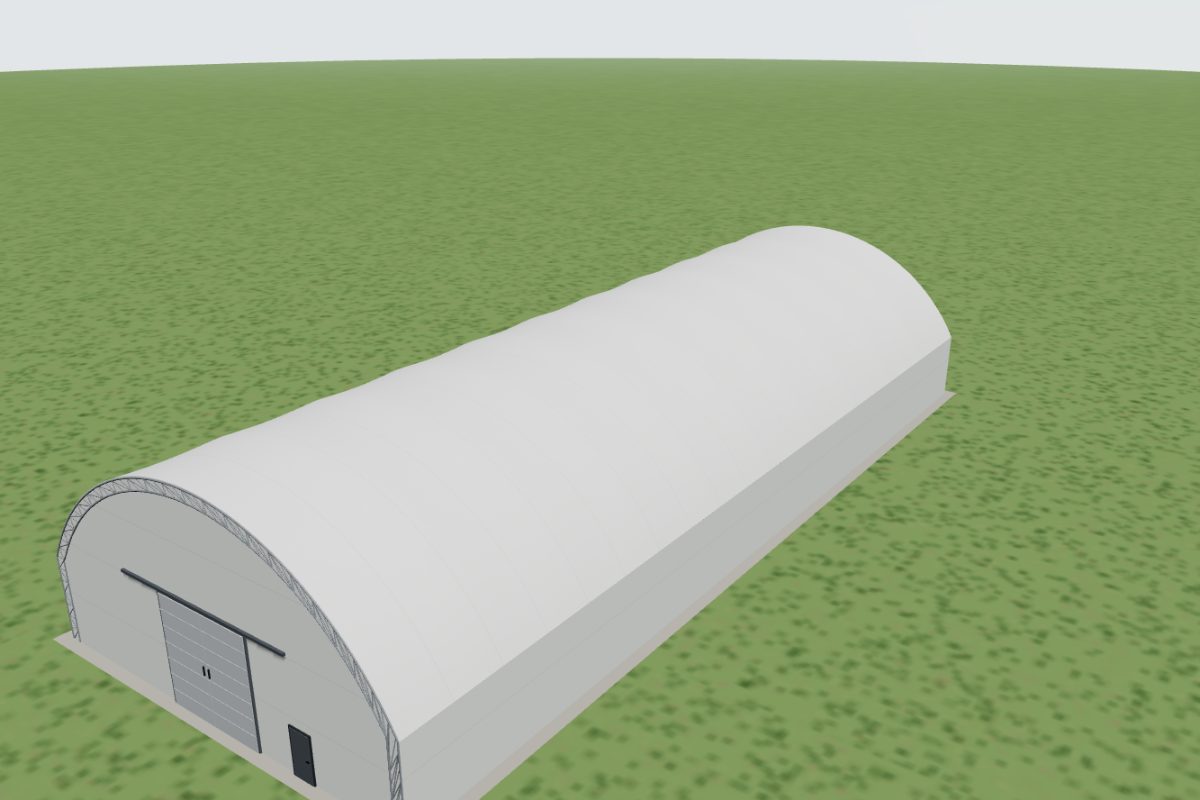
Hay and straw keep their value only when they stay dry. A tent hall with an arched roof keeps rain and snow off the bales, lets air move through the store and leaves a clear floor for the loader. Plan the size from your bale format and stacking height, and keep fresh hay under watch in the first weeks.
Typical uses
- Round and square hay bales
- Straw for bedding
- Feed and bedding next to the barn
- Bale stores for horse farms
- Contractors' and traders' bale stores
Example sizes and estimated prices
Indicative estimates for the standard configuration, excluding VAT and installation. Your design can change the price considerably.
| Size | Floor area | Capacity | Estimated price | |
|---|---|---|---|---|
| 15 × 36 m | 540 m² | ≈ 703 pallets | €22,800 – €26,500 | Open in 3D → |
| 20 × 51 m | 1,020 m² | ≈ 1,328 pallets | €43,600 – €50,600 | Open in 3D → |
| 28 × 75 m | 2,100 m² | ≈ 2,734 pallets | €115,000 – €134,000 | Open in 3D → |
Plan the size from your bales
Measure your own bales; these formats are common:
| Bale | Typical size | Weight of a straw bale |
|---|---|---|
| Round bale, 4 × 4 ft | About 1.2 m across, 1.2 m wide | About 150 kg |
| Round bale, 5 × 4 ft | About 1.5 m across, 1.2 m wide | About 245 kg |
| Large square bale, 8 × 4 × 3 ft | About 2.4 × 1.2 × 0.9 m | About 400 kg |
| Large square bale, 8 × 4 × 4 ft | About 2.4 × 1.2 × 1.2 m | About 580 kg |
| Small square bale | Stacked by hand or with a bale grab | About 12.5 kg |
Straw weights from Teagasc; hay bales of the same size are heavier. Large square balers also make bales of 0.8 × 0.7 m cross-section.
- Width: choose a span that takes whole rows of bales plus a driving lane for your loader. For example, a 15 m span with 0.5 m gaps at the walls holds eleven bales of 1.2 m side by side.
- Height: side walls of 3–4 m let you stack higher near the walls; keep the top layer below the curve of the roof.
- Gaps: leave space between the stack and the walls so air can move and the bales do not press against the cover.
- Doors: wide doors in the gable ends for the loader and trailers; keep the lane to them clear.
Keep fresh hay under watch
Hay heats up when it is baled too moist, and in the worst case it can catch fire by itself. Guidance from agricultural advisers:
- Bale it dry. The Bavarian State Research Center for Agriculture (LfL) gives 16 % moisture as the limit for large square bales. US extension services recommend 20 % or less for small square bales and 18 % or less for large square and round bales.
- Measure the temperature inside the stack with a hay probe. The risk is highest in the first weeks: the LfL measured the highest temperatures in the first two to three weeks, and South Dakota State University Extension advises checking twice a day for six weeks.
- Act on the reading. Above 60 °C, measure at least every 5 hours; at 70 °C, call the fire brigade (LfL). Move hot hay only with the fire brigade present.
- Know the local rules. In Bavaria, for example, temperature checks in hay stores are mandatory; ask your fire service or insurer what applies to you.
Fire safety and layout
- Store hay and straw apart from machinery, fuel and workshops, as your insurer and the local fire rules require.
- Keep the driving lanes and the gable doors clear, so that the loader and the fire brigade can reach every part of the stack.
- Ask for the fire classification of the PVC cover (for example B1 or M2) if your insurer needs it; see the glossary.
Which hall
An arched tent hall suits bales well: the stack follows the round roof, and ventilation through open gables, side curtains or a ridge vent carries moisture away. If you also park machinery in the same building, compare with a machinery garage with taller side walls.
Sources (checked 7 October 2026)
- Self-heating of hay stored in large square bales, LfL Bayern (2010)
- Minimizing hay storage loss, heating or fires, South Dakota State University Extension (2021)
- Hay fire prevention and control, Virginia Cooperative Extension publication 442-105 (2009)
- Straw bale sizes and weights, Teagasc
- Large square baler chamber sizes (120 × 90 cm and 80 × 70 cm), Agriland (2016)
Frequently asked questions
How big should a hay barn tent be?
+
Work from your bales: how many rows fit across the span with a driving lane, and how many layers fit under the roof. The tent size calculator turns the floor area you need into spans and lengths.
Should a hay store have side walls?
+
Open sides improve airflow, but rain and snow can blow in. Side curtains that can be rolled up give you both options.
When is the fire risk from hay highest?
+
In the first weeks after baling, when moist hay heats up. Advisers recommend measuring the stack temperature regularly in that period and calling the fire brigade at about 70 °C.
Related
Arched tent halls
Round-roof steel and PVC halls for hay, machinery, animals and storage.
Agricultural tents
Insulated, ventilated stores for harvests, drying and growing.
Machinery & vehicle garages
High, wide garages for tractors, trucks and machinery.
Cattle barns
Wide, bright barns for beef and dairy cattle with tractor access.
How are tent halls anchored?
Anchoring options for slabs, soil and temporary sites.
Ready to plan your tent?
Design it in 3D in a few minutes, see an estimate and request offers. Free and without registration.